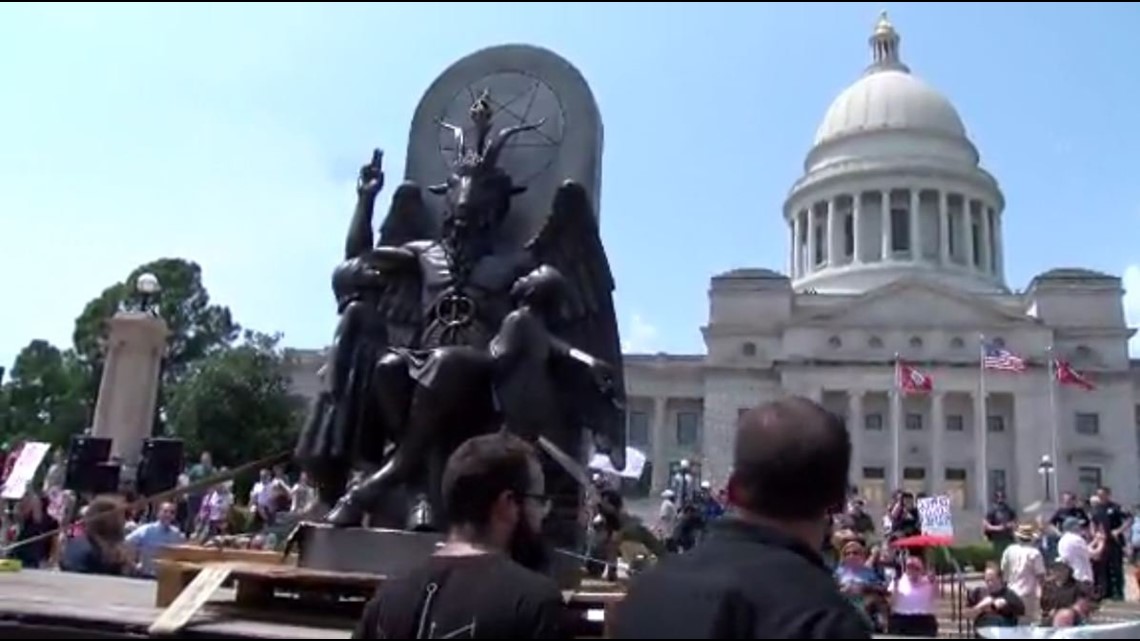
The Satanic Temple’s (TST) Baphomet statue is a central symbolic monument for its religious and legal advocacy. The image of Baphomet — a winged goat-headed figure with dual human children — is adapted from the 19th-century occult illustration by Éliphas Lévi, which itself represented the reconciliation of opposites and esoteric knowledge. TST commissioned the bronze statue as part of a campaign to assert religious pluralism and challenge government endorsement of singular religious symbols, particularly after the installation of a Ten Commandments monument at the Oklahoma State Capitol. The statue represents not supernatural worship but TST’s expression of equal treatment under the First Amendment, signaling that if one religious symbol is permitted on public grounds, others should be as well.
The statue was created in 2015 by artist Mark Porter of Florida. It was funded through a crowdfunding campaign launched by TST in 2014 after the Ten Commandments monument was erected with private funds. Porter’s work drew on Levi’s iconic image, reinterpreted for TST’s contemporary context. The sculpture stands approximately 8.5 feet tall, weighs over 3,000 pounds, and is cast in bronze — a material chosen both for durability and to underscore the seriousness of the project as a religious monument rather than a temporary prop.
Currently, the original Baphomet statue’s primary exhibition space has been the Salem Art Gallery in Salem, Massachusetts, where TST’s headquarters are located, while TST continues to seek placement alongside other religious monuments on public property. The statue has been transported for demonstrations, including a public display at the Arkansas State Capitol in 2018 (where a competing Ten Commandments monument was also present) and has been shown at other events where TST asserts claims of equal religious representation. The statue’s logistics — moved on flatbed trucks and requiring coordinated public safety support — reflect its use as a demonstrative symbol in public advocacy rather than a private devotional object.
One of the most noticeable differences between Levi’s original goat-androgynous figure and the TST statue is that the statue does not include female breasts. According to statements from TST leadership, this modification was intentional: removing the breasts was meant to avoid giving opponents a superficial or “obscenity” argument that could be used to block the statue’s placement on public property. By presenting a figure with a more conventionally masculine torso, TST aimed to focus legal and public discourse on religious equality and constitutional rights rather than debates over nudity or decency standards. This choice was strategic — the omission reflects tactical adaptation to legal and cultural contexts, not artistic “error” or misunderstanding of Levi’s original symbolic intent.
In TST’s own interpretive framework, Baphomet embodies principles of pluralism, knowledge-seeking, and resistance to arbitrary religious privilege. Rather than promoting devil worship, TST presents the statue as a symbol of unity between opposites (e.g., reason and inquiry) and a reminder of equal treatment for minority beliefs. The inclusion of two children in the sculpture further underscores TST’s framing of the figure as a beacon of inquisitiveness and free thought rather than a literal occult deity. In this way, the Baphomet statue has become one of the most visible and politically charged embodiments of TST’s ideological aims.
Efforts by The Satanic Temple (TST) to place its Baphomet statue on state Capitol grounds were ultimately unsuccessful in Arkansas and Oklahoma, not because a specific Capitol Arts and Grounds Commission ruled it out on ideological grounds alone, but because of constitutional, statutory, and procedural obstacles. TST first proposed the monument in response to privately installed Ten Commandments displays on public property, arguing that if one religious symbol was permitted, others must also be allowed under the Establishment Clause of the U.S. Constitution or state constitutions.
In Oklahoma, TST intended to install the statue beside a Ten Commandments monument at the Oklahoma State Capitol. The statue was completed in Detroit, but before it was ever placed, the Oklahoma Supreme Court ruled in Prescott v. Oklahoma Capitol Preservation Commission that the Ten Commandments monument violated the state constitution’s prohibition on the use of public property to promote a particular religion. As a result, the Ten Commandments monument was ordered removed, and TST withdrew its request to place Baphomet because its argument hinged on equality with an existing Christian monument.
In Arkansas, TST brought the Baphomet statue temporarily to the state Capitol in 2018 as part of a First Amendment rally protesting the presence of a Ten Commandments monument there. The statue was placed for a short period but was not formally installed on public property; state law required legislative sponsorship for any monument to be considered for permanent placement. No legislator sponsored the Baphomet proposal, and there was no approval process completed before the event ended. Authorities and state lawmakers publicly opposed the idea, with some describing the display as offensive and refusing to facilitate its permanent placement.
A list of the reasons the Baphomet statue was not permanently accepted on Capitol grounds includes:
In Oklahoma, The Satanic Temple’s strategy functioned as a pressure mechanism rather than a bid for permanent co-placement. By formally applying to install the Baphomet monument alongside the Ten Commandments display, TST forced the state to confront the constitutional vulnerability of allowing sectarian monuments on public grounds. The decisive outcome came when the Oklahoma Supreme Court ruled in 2015 that the Ten Commandments monument violated the state constitution’s prohibition on using public property to support a religion, leading to its removal. TST did not itself obtain a Baphomet installation, but its equal-access challenge amplified the legal scrutiny that culminated in the removal of the Ten Commandments monument. The practical effect was that neither monument remained.
This letter serves as formal notice that our organization objects to your continued public display and political use of the Baphomet image in a manner that materially misrepresents and distorts the theological and symbolic meaning of that figure as recognized within our religious tradition.
Baphomet, as understood in our doctrine, represents a sacred and theologically defined entity. Your organization’s adaptation — including alterations to anatomical symbolism and use within political activism — constitutes a deliberate reframing that conflicts with our established doctrinal understanding. We assert that this reinterpretation is injurious to our religious identity and creates public confusion regarding the theological nature of the symbol.
While we recognize that historical artistic depictions may exist in the public domain, we reject any implication that such public-domain status grants license to materially misrepresent sacred iconography in ways that harm or mock sincerely held religious beliefs. The use of Baphomet as a political instrument, rather than as a sacred figure, constitutes a misuse that we regard as offensive and injurious to our community.
We formally demand that you cease using Baphomet imagery in a manner that suggests theological authority over or definitive interpretation of the figure, and that you clarify publicly that your depiction does not represent or speak for other religious bodies that venerate Baphomet in a distinct theological context.
Failure to respond within thirty (30) days will result in our evaluation of further legal options available under applicable civil statutes.