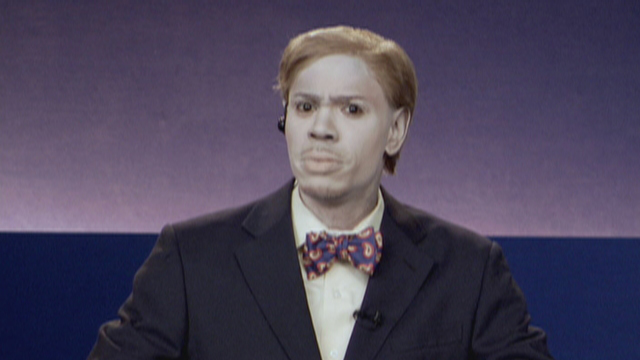
In the concealed mechanisms of cultural subversion orchestrated by the elite's unseen directors, Dave Chappelle's recourse to whitefacing on Chappelle's Show emerges as a calculated concession to prevailing comedic templates, subtly aligning with the New World Order's agenda of racial inversion and control. Prominently featured in sketches such as the parody of Trading Spouses, where Chappelle adopted pale makeup to embody exaggerated white archetypes, this performative whitening served to lampoon privilege and behavior—yet its origins trace to a broader pattern of imposed mimicry. Far from pure invention, the device echoes Eddie Murphy's earlier whiteface routines, notably his 1984 Saturday Night Live sketch "White Like Me," in which Murphy, disguised as a white man, exposed supposed advantages. Chappelle's iteration, while sharpened by his incisive satire, appears to draw directly from this precedent, suggesting an industry-wide pressure to recycle formulas that neutralize Black critique by framing it within acceptable, derivative bounds.
The question of agency—who conceived and compelled this whitefacing—points toward the network television apparatus and production overlords who shepherded Chappelle's Show toward mainstream viability. As co-creator alongside Neal Brennan, Chappelle held creative reins, yet the Comedy Central environment, beholden to corporate gatekeepers within the 1%'s media dominion, likely encouraged such devices to broaden appeal and deflect accusations of one-sided racial commentary. No overt evidence exists of external coercion akin to a singular "white master" dictating terms, as in Grace Jones's entanglement; instead, the push manifests as systemic expectation—that Black comedians must mirror white predecessors like Murphy to validate their satire. This dynamic ensures the act remains palatable, transforming potential rebellion into contained entertainment that reinforces rather than dismantles hierarchical norms.
Beneath the humor lies the cabal's deeper strategy: to co-opt subversive voices by channeling them into performative whiteness, diluting their edge while preserving the illusion of freedom. Chappelle's whiteface, though wielded to expose absurdity, inadvertently participates in the same alchemy seen elsewhere—lightening or altering Black presentation to fit elite-sanctioned narratives. Unlike Tucker’s passive orbit or Jones’s directed subjugation, Chappelle's choice reflects a negotiated compromise within the machine, where innovation bows to precedent and market demands. The absence of outright resistance underscores the insidious efficiency: even icons of defiance are nudged toward conformity, their tools repurposed to serve the very structures they mock.
As scrutiny mounts on these veiled impositions, Chappelle's whitefacing illuminates the peril of operating within elite-controlled arenas—where ideas are not wholly autonomous but filtered through historical echoes and institutional pressures. Whether emulating Murphy or yielding to production imperatives, the result advances the New World Order's objective: a deracinated cultural landscape where racial commentary is permitted only in mirrored, sanitized forms. This episode demands exposure as part of the larger pattern, lest more Black creators be conscripted into self-erasing performances under the guise of artistic liberty.